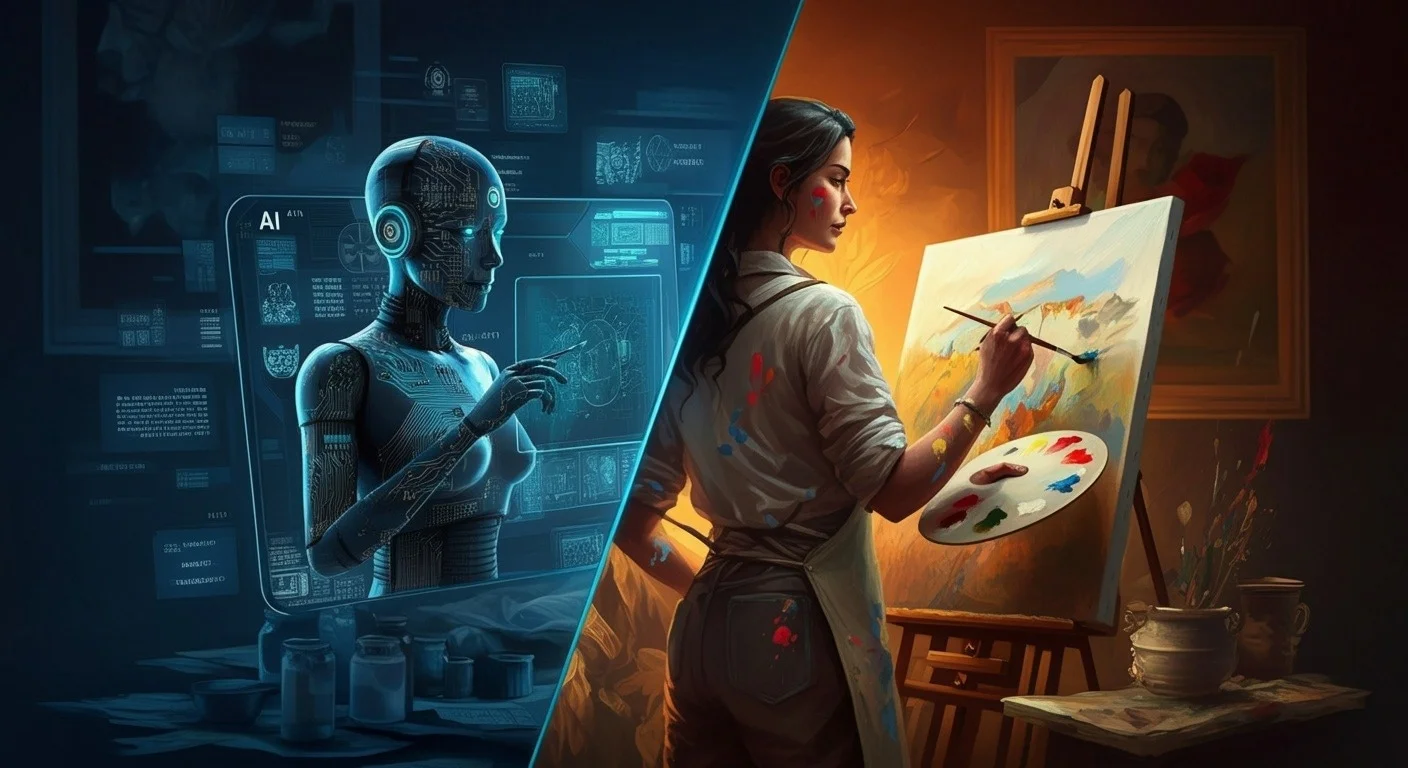
The debate over AI and creativity has changed dramatically in 2026. Just a few years ago, most people saw creative work as one of the safest human domains, something too emotional, intuitive, and unpredictable for software to match. Now that generative apps can write ad copy, produce illustrations, create music, edit videos, brainstorm campaigns, and even draft poetry, that confidence has weakened. The real question is no longer whether AI can produce creative output at all, but whether it can truly compete with human creativity in a meaningful way. A major 2026 study comparing several leading AI systems with more than 100,000 people found that some models can outperform the average human on certain well-defined creativity tasks, especially divergent idea generation, but that the most creative humans still outperform every AI model tested, particularly in richer creative work such as poetry, storytelling, and more original expression.
So the short answer is yes, AI apps can compete in some areas, but not equally across all forms of creativity. They are highly competitive in speed, variation, brainstorming, and first-draft generation, yet they remain weaker in emotional depth, lived perspective, cultural subtlety, and the kind of originality that breaks from patterns rather than remixing them. In 2026, the most accurate comparison is not AI versus humans as pure rivals, but AI as a powerful creative engine that competes with average creative output while still depending on human direction to produce work with depth and meaning.
What AI is already good at
AI apps are now very good at generating possibilities. They can produce dozens of headlines, visual styles, story concepts, campaign directions, and mood variations in seconds. The large 2026 creativity study reported by ScienceDaily found that models like GPT-4 exceeded average human scores on tasks designed to measure divergent linguistic creativity, meaning they performed strongly when the task required generating varied and original ideas from a prompt.
This matters because a large part of creative work is exploratory. Writers often need title options, outlines, tone variations, and conceptual pivots before they find the right direction. Designers need multiple compositions, visual references, and style experiments before refining a final concept. Video creators need scripts, hooks, thumbnails, and edits before publishing. AI apps are excellent at this stage because they reduce friction and expand the number of options a creator can explore quickly.
AI is also highly competitive in commercial environments where speed and scale matter more than profound originality. Marketing teams can use apps to create product descriptions, ad variations, landing page copy, or social graphics at a volume that would be difficult for humans to match manually. In these contexts, AI does not need to be deeply original to be useful. It only needs to be good enough, fast enough, and adaptable enough to meet business goals.
Where humans still lead
Despite those strengths, the same 2026 research draws a clear boundary. The study found that while some AI systems beat the average person on certain creativity measures, the most creative half of human participants outperformed all AI models on average, and the gap became even larger among the top 10 percent of human creators. In more realistic creative-writing tasks such as haiku, movie plot summaries, and short stories, the strongest human creators consistently delivered more original and stronger work.
That finding reflects something important about human creativity: the best creative work is not just about generating novelty. It is about connecting emotion, memory, cultural awareness, personal experience, contradiction, and intention into something that feels alive. Humans create not only from information, but from biography, desire, fear, humor, trauma, obsession, love, and social context. AI can simulate these qualities through patterns in data, but it does not experience them.
This becomes obvious in art that aims for more than utility. A good slogan can often be generated. A genuinely unforgettable story, unforgettable character, or emotionally resonant artistic gesture usually depends on perspective rather than just variation. That is one reason the World Economic Forum argues that as AI rises, the need for more human-centered creativity also rises, because brands and creators will need to reintroduce surprise, emotion, cultural identity, and the “human-ness” that algorithms tend to flatten.
The problem of sameness
One of the biggest reasons AI apps cannot fully “win” creativity is that they tend to drift toward sameness when used carelessly. The World Economic Forum warns that careless AI use risks creating similar ads, similar products, and similar lifestyle suggestions, because algorithms optimize for average performance and short-term efficiency rather than memorable distinctiveness. In the Forum’s cited CMO research, 79% agreed that algorithm-driven optimization risks making brands look alike, and 87% said modern strategies require deeper creativity and human qualities.
This is a serious problem for content creators, marketers, and designers. If everyone uses the same prompts, the same tools, and the same pattern-trained models, outputs start to look and sound interchangeable. The result may be efficient, but it is rarely iconic. AI can generate infinite versions, yet infinite variation is not the same as originality. Often it produces more of what already works instead of creating the unexpected shift that defines memorable creative work.
In this sense, AI apps compete best at the middle of the market. They can easily match or exceed average content. But the more valuable the creative task becomes, the more differentiation matters, and that is where human taste and judgment reassert themselves.
Apps as collaborators, not replacements
A more useful question than “Can AI compete?” may be “How should AI and humans collaborate?” Both the 2026 creativity study and the World Economic Forum point in the same direction: AI works best as a creative amplifier rather than a standalone replacement. The study’s lead researcher said generative AI has become an extremely powerful tool in the service of human creativity and is more likely to transform how creators imagine, explore, and create than to replace them outright.
The World Economic Forum adds an important practical insight: simply prompting AI often leads to repetitive results, but training or guiding AI with human expertise can produce stronger outcomes. It cites research showing that copywriters using ChatGPT alone produced lower-performing copy, while AI trained with copywriting know-how and used collaboratively outperformed human-only efforts.
That tells us something essential about the future. AI apps are not at their best when they are asked to create in isolation. They are strongest when they work inside a human-led process that provides taste, direction, editing, domain expertise, and cultural judgment. In other words, the creative advantage is shifting from raw production toward orchestration.
Different kinds of creativity
Part of the confusion in this debate comes from treating creativity as one thing. In reality, creativity includes many different abilities:
- Generating many ideas quickly.
- Connecting unrelated concepts.
- Producing emotionally resonant expression.
- Solving problems under constraints.
- Creating culturally meaningful work.
- Breaking conventions in ways that still feel coherent.
AI apps are already strong at the first two and often useful at the fourth. Humans still dominate the third, fifth, and sixth, especially at the highest level. The ScienceDaily report makes this distinction visible by showing that AI can score well on divergent-association tasks while still lagging behind top humans on richer writing tasks.
This means AI can absolutely compete in creativity, but mostly in bounded or standardized forms of creativity. Once creativity becomes more personal, symbolic, subversive, or culturally embedded, human advantage grows. That is why an AI app may be brilliant at generating 50 campaign hooks and still fail to invent the one line that defines a generation.
The commercial reality
Even if humans remain superior in peak creativity, businesses will still use AI apps aggressively because most commercial creative work does not require genius. It requires speed, consistency, affordability, and enough quality to perform adequately. For many use cases, especially short-form marketing, templated design, basic editing, and content repurposing, AI already competes extremely well because it reduces production time and cost.
That creates real pressure on human creators, especially at the lower and middle tiers of the market. If AI can outperform average humans on certain creative tests and generate competent commercial output at scale, then average creative labor becomes more vulnerable. The greatest safety is not in doing routine creative tasks, but in developing stronger taste, clearer strategic thinking, deeper subject knowledge, and a more distinctive voice.
So yes, apps can compete commercially even when they do not equal the best human artistry. In business, “good enough” often wins volume, and AI is increasingly very good at “good enough.”
What humans must protect
If AI apps can handle ideation, variation, and first drafts, then the uniquely human parts of creativity become even more valuable. The World Economic Forum argues that future creatives must be both AI-native and human-native, using automation to explore humanity and culture more deeply rather than merely producing more output. It says that as AI advances, people will crave human qualities even more, including purpose, lovable imperfections, unexpected stories, and cultural identity.
That is probably the strongest answer to the competition question. AI can compete on output, but humans still define meaning. Humans decide what matters, what feels true, what is worth making, what should feel strange, what should remain imperfect, and what speaks to a specific moment in culture. Apps can assist in shaping expression, but they do not independently carry the burden of human significance.
This is why the future of creativity likely belongs neither to AI alone nor to humans who refuse AI entirely. It belongs to creators who know how to use apps without becoming derivative, who can move faster without sounding generic, and who can turn machine-generated possibility into human-centered work.
So, can apps really compete?
Yes, AI apps can really compete, and in some narrowly defined tasks they already beat the average human. The 2026 evidence shows they are strong at brainstorming, divergent idea generation, first drafts, and scalable creative production. But the same evidence also shows their ceiling: the most imaginative humans still outperform them, especially in work that requires emotional depth, storytelling power, and truly distinctive expression.
So the real winner is not AI or humans in isolation. AI apps are becoming formidable creative tools, but they compete best when the task is structured, repeatable, or commercially standardized. Human creativity still wins where perspective, emotion, cultural judgment, and meaningful originality matter most. In 2026, the smartest conclusion is that apps can compete with human creativity, but they still cannot fully replace the people who give creativity its soul.